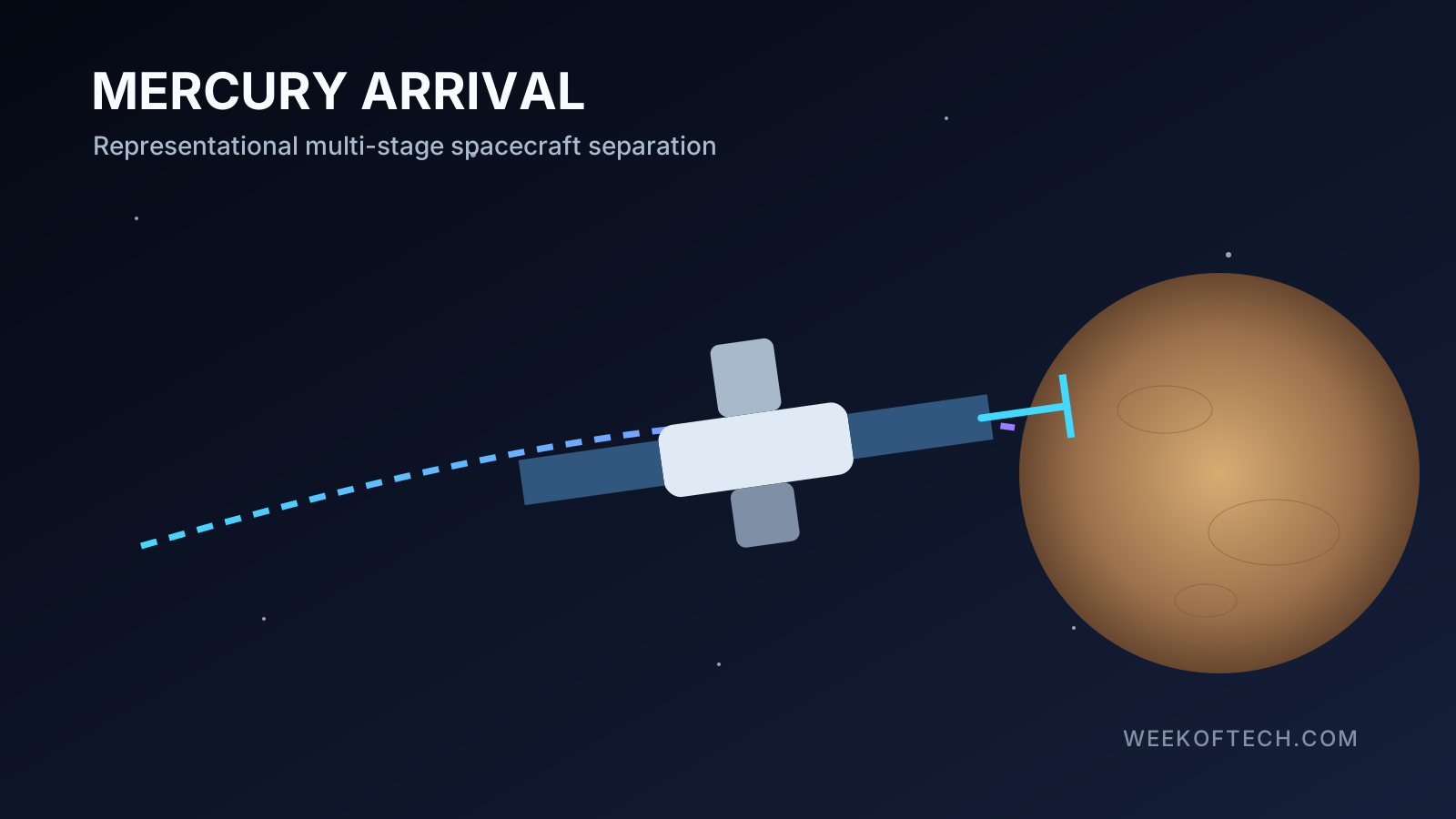
BepiColombo has started the final, unusually complicated phase of its journey to Mercury after the mission's Mercury Transfer Module (MTM) successfully separated from the spacecraft stack.
The European Space Agency reported the milestone on September 7 after separation operations on September 3. The event is more than a piece of spacecraft housekeeping: it changes how BepiColombo is propelled and begins a six-month sequence that will eventually separate and place its two scientific spacecraft into distinct Mercury orbits.
ESA says the mission has travelled about 9.9 billion kilometres through the inner Solar System over eight years and completed nine planetary flybys to reach this point.
Why getting to Mercury is so difficult
Mercury is close to the Sun, but that does not make it easy to reach. A spacecraft travelling inward from Earth gains speed as it falls deeper into the Sun's gravitational well. To enter orbit around Mercury rather than simply fly past it, BepiColombo has had to shed energy carefully over a long trajectory.
The mission used repeated planetary flybys and long periods of low-thrust propulsion instead of relying on one enormous braking manoeuvre at the end.
That is where the MTM came in. It supplied power and solar-electric propulsion during the interplanetary cruise. ESA describes the module as roughly the size of a small car, with two 15-metre solar wings and four ion thrusters.
Those thrusters used solar electricity to ionise xenon and expel the resulting plasma. The thrust is gentle compared with a chemical rocket, but it can be applied for very long periods while using relatively little propellant. For an eight-year trajectory requiring gradual changes in velocity, that trade-off is valuable.
The separation had a built-in wait of nearly two hours
The actual MTM separation was scheduled for 14:00 CEST on September 3 while the spacecraft was around 200 million kilometres from Earth.
Mission control could not simply watch the event happen in real time. ESA says a preliminary Doppler signature at 14:20 gave the team an early indication that the module had separated. Full telemetry confirming the result reached mission control at 15:49 CEST.
After separation, the remaining spacecraft stack entered safe mode, adjusted its attitude and reconfigured before sending status information back to Earth.
The communication delay is a useful reminder of how planetary spacecraft operations differ from terrestrial remote control. At these distances, a mission team sends commands, waits for radio signals to cross interplanetary space, and relies heavily on onboard sequences and fault protection during critical events.
MTM is finished; the Mercury Planetary Orbiter now takes over propulsion
With its cruise job complete, the MTM has no antenna or onboard computer that would allow it to operate independently. ESA says it will remain in a stable orbit around the Sun.
The remaining BepiColombo stack now uses the Mercury Planetary Orbiter's chemical propulsion system for trajectory corrections and the later orbit-insertion sequence.
That transition is significant because BepiColombo is not one spacecraft that simply brakes into its final orbit. The composite vehicle still has to be reconfigured and divided into the two scientific orbiters that will study Mercury from different trajectories.
Arrival is a sequence, not a single date
ESA says the next major step is Mercury orbit insertion on November 21, 2026. JAXA's Mercury Magnetospheric Orbiter, known as Mio, is expected to be deployed in early December.
The ESA Mercury Planetary Orbiter will then continue manoeuvring toward its final science orbit, which is planned for March 2027. ESA expects the two spacecraft to begin their main scientific investigations by April 2027.
That staggered timetable is why describing BepiColombo as having “arrived at Mercury” on a single day would be misleading. The September MTM separation opens the arrival phase; the operational architecture then unfolds over months.
What the two-orbiter design enables
BepiColombo is a joint ESA/JAXA mission built around complementary spacecraft. ESA's Mercury Planetary Orbiter is focused on the planet's surface, composition, interior and surrounding environment, while JAXA's Mio is designed to investigate Mercury's magnetic environment and magnetosphere.
Operating two spacecraft around the planet gives researchers the ability to make measurements from different locations and with different instrument suites rather than forcing every scientific objective onto one platform.
The immediate engineering question is simpler: execute each separation and propulsion step accurately enough to put both orbiters where they need to be.
The successful MTM separation removes one major uncertainty. It does not end the arrival challenge; it starts the part of the mission in which a single cruise stack becomes a coordinated two-spacecraft observatory around one of the hardest planets in the Solar System to reach.