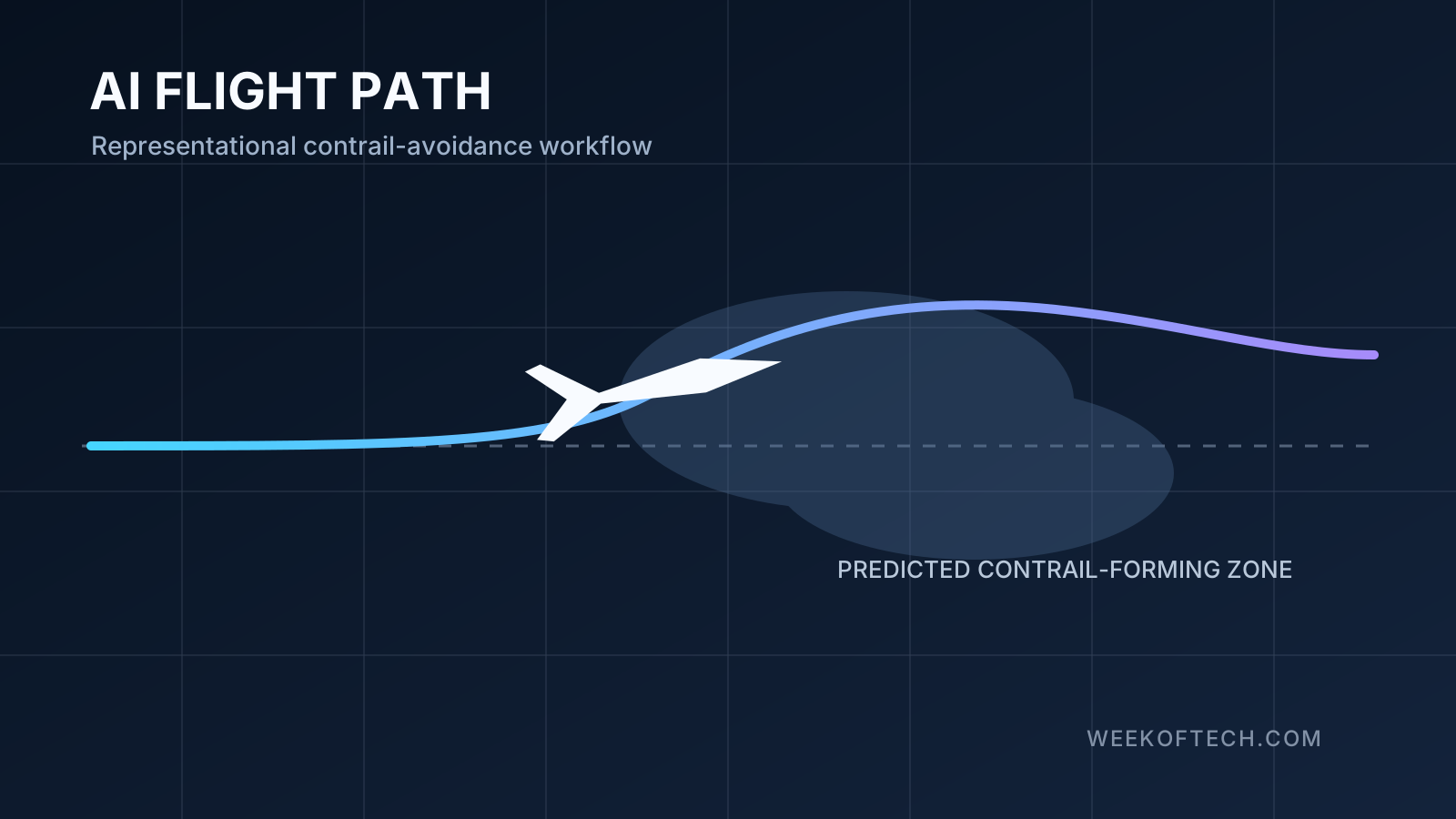
Google is expanding an operational trial with Cathay Pacific that uses artificial intelligence, satellite imagery and weather data to help pilots avoid atmospheric regions where long-lived aircraft contrails are likely to form.
The project is technically interesting because it does not require a new aircraft or engine. Instead, the intervention is largely informational: predict where persistent contrails are likely, move that information into normal flight-planning and cockpit workflows, and make small altitude changes when operational conditions allow.
Google says more than 80 flights in the initial Cathay Pacific trial followed contrail-avoidance routes. Its satellite-based analysis estimates that those flights reduced the warming impact of contrails by roughly 40%. That figure is a Google estimate from the trial, not an independently verified Week of Tech measurement.
From a model prediction to a cockpit decision
Persistent contrails form only under particular combinations of temperature and humidity. That makes the problem well suited to prediction: the useful question for an airline is not simply whether contrails exist, but where the atmosphere is likely to support them along a planned route.
Google says its system combines AI predictions, satellite imagery and weather intelligence to identify those zones before and during a flight. Cathay Pacific then feeds the resulting forecasts to the flight deck through in-flight Wi-Fi and its Electronic Flight Folder.
That integration matters. A technically accurate model has limited operational value if its output sits in a separate research dashboard. Putting the forecast beside information pilots and dispatchers already use turns the model into a decision-support layer rather than a standalone AI demonstration.
The intended intervention is a modest altitude change around a predicted contrail-forming region. Flight crews already make altitude changes for traffic, turbulence, weather and efficiency, so the concept fits an existing operational pattern. Any real flight change, however, still has to sit inside normal safety, air-traffic and fuel constraints.
The first phase is large enough to be useful, but still a trial
Google says the operational programme targeted more than 100 Cathay Pacific flights and that more than 80 actually followed contrail-avoidance routes. The company reports an estimated 40% reduction in contrail warming impact for those flights based on its satellite analysis.
The Hong Kong–Singapore corridor was among the routes tested. Google says interventions on that route accounted for more than half of the trial's total estimated emissions reductions, suggesting the benefit may be concentrated in particular atmospheric and route conditions rather than distributed evenly across every flight.
That is one reason the next phase matters. A larger trial across Asia and trans-Pacific operations can test how often useful avoidance opportunities occur, how much operational flexibility is available, and how much additional fuel or complexity is introduced by route changes.
Google is also working with Contrails.org as it expands the programme.
Why contrail avoidance is a different kind of aviation technology
Aviation decarbonisation is often discussed in terms of new fuels, propulsion systems or aircraft designs. Those approaches can require new production capacity, certification, infrastructure and fleet replacement.
Contrail avoidance is different. It attempts to reduce a climate effect from current aircraft by changing where they fly for a small portion of a journey.
That does not make the problem trivial. Forecast quality has to be high enough for the information to be useful, the atmospheric prediction has to correspond to what actually happens after the aircraft passes, and any altitude change can affect fuel burn and traffic management. A climate benefit also needs to be evaluated as a net effect rather than from contrail reduction alone.
The technology therefore sits at the intersection of machine learning, weather prediction, satellite observation, airline dispatch and air-traffic operations.
What to watch next
The most important result from the expanded trial will not be whether AI can produce another forecast. It will be whether the system can repeatedly produce actionable forecasts that airlines can use at scale without creating disproportionate operational costs.
Useful evidence would include performance across different seasons and routes, the frequency with which pilots can act on suggested altitude changes, any fuel penalty, and independent assessment of the resulting climate effect.
For now, Google and Cathay Pacific have moved the idea beyond simulation and into routine commercial-flight workflows. The next phase should show whether that workflow can become a repeatable part of airline operations rather than a carefully managed experiment.